Inclusive Rigour
Developing complexity-aware, community-centred approaches to evaluating peacebuilding.
2021 onwards · International · Core team member · Inclusive Rigour Co-Lab
Inclusive rigour reframes what makes evaluation robust. The concept was first proposed by Robert Chambers, who argued that the complexity of development and social change calls for a different kind of rigour: one that values many ways of knowing and the knowledge of people affected by change. Rather than locating rigour in the choice of method alone, inclusive rigour grounds it in thoughtful, complexity-aware design and in meaningful participation, The Inclusive Rigour Co-Lab brings together evaluators, practitioners, researchers and funders to develop this idea and put it into practice.
The Co-Lab has developed the Inclusive Rigour framework, which treats rigour as an active, iterative practice rather than something guaranteed by the choice of method. It brings together three connected domains:
Methodological bricolage: the how, choosing and mixing methods to suit the context and understand change
Participation and inclusion: the who, asking whose knowledge counts and whether processes open or close space for marginalised voices
Utilisation: the why, making sure evidence responds to what people need to make decisions
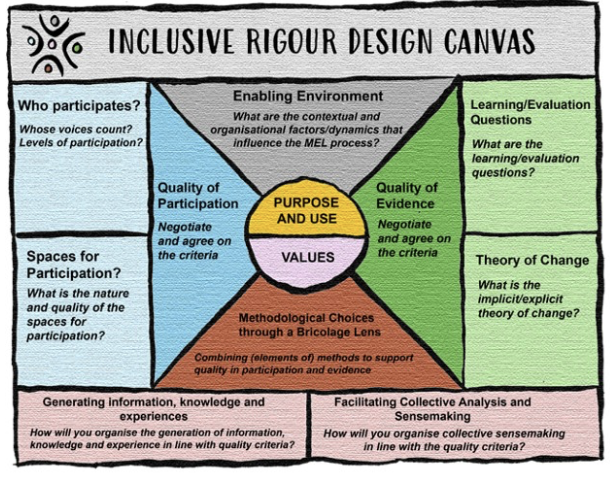
The framework has been piloted, refined and shared across the evaluation and peacebuilding fields. The Inclusive Rigour Canvas turns it into a practical tool that teams can use to design and reflect on their own evaluations.
As a member of the core team, I contribute to developing the framework, to the Co-Lab projects and strategy, to decisions on pilot projects ad developing case studies. I bring expertise in participatory visual methods and peace and conflict scholarship.
Outputs
Apgar, M., Bradburn, H., Rohrbach, L., Wingender, L., Cubillos Rodriguez, E., Baez-Silva Arias, A., Dioma, A., Fairey, T., Gray, S., Alak, A.C.D. and Deprez, S. (2024). ‘Rethinking Rigour to Embrace Complexity in Peacebuilding Evaluation’. Evaluation.
Fairey, T., Firchow, P. and Dixon, P. (2022). ‘Images and Indicators: Mixing Participatory Methods to Build Inclusive Rigour’. Action Research.
The Inclusive Rigour Canvas [2026]
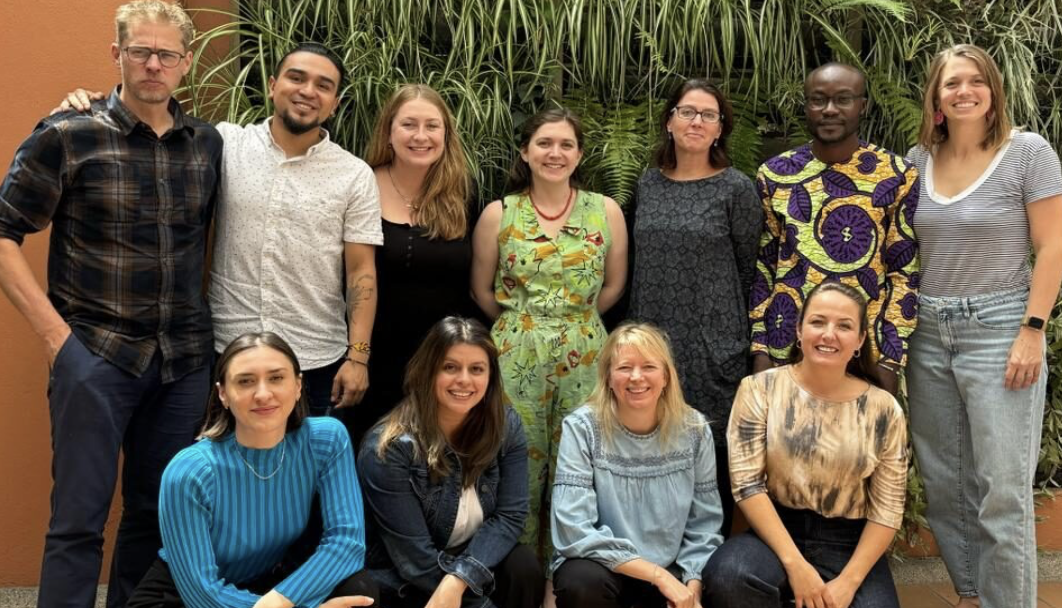
Inclusive Rigour Co-Lab members in Bogota, Colombia, 2021